
Quick Answer
Predictive analytics uses historical data, statistics, and machine learning (where computers learn patterns from data on their own) to forecast what is likely to happen next. It helps businesses reduce risk, spot opportunities, and make smarter decisions before problems occur. From healthcare to finance, predictive analytics is now a core part of how AI systems think and act.
Key Highlights
- Predictive analytics turns past data into future forecasts.
- It works by combining statistics, machine learning, and pattern recognition (the ability to spot recurring trends in data) to generate predictions.
- There are four main model types: regression, classification, time series, and neural networks.
- Real-world use cases include healthcare risk scoring, fraud detection, customer churn (when customers stop using a product or service), and inventory planning.
- AI has dramatically improved predictive analytics by enabling faster, more accurate, and real-time forecasting.
- Common tools include Python, R, IBM SPSS, DataRobot, and Google Cloud AutoML.
- Even powerful models fail without clean data, proper validation, and human oversight.
Table of Contents
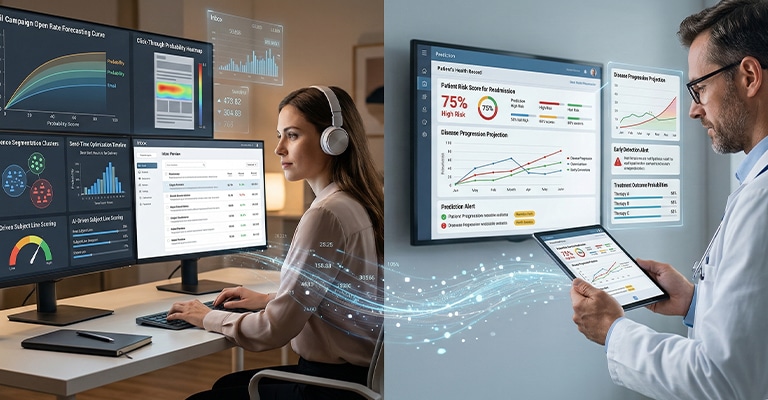
You check your email. A product you almost bought is right there in your inbox. You go to the doctor. Your risk for diabetes gets flagged before any symptoms appear. You log into Netflix. It already knows what you want to watch next.
None of this is magic. It is predictive analytics at work.
Most guides oversimplify this topic or drown you in formulas. This one is different. You will walk away knowing exactly what predictive analytics is and how it works. You will also see where it shows up in your daily life.
This guide is for students, early-career professionals, and anyone curious about AI. You will get clear, practical knowledge grounded in real examples. Every technical term is explained in plain language as we go.
Predictive analytics is one of the most practical applications of machine learning techniques. Predictive analytics is now one of the most widely used AI capabilities across industries (IBM). Let us start from the beginning.
What Is Predictive Analytics?
Predictive analytics is the process of using historical data, mathematical models, and machine learning to forecast future outcomes. Think of it as pattern-based forecasting.
Imagine you have a weather app. It does not just tell you today’s temperature. It predicts tomorrow’s rain based on past atmospheric patterns. That is predictive analytics in action.
It answers one core question: “What is likely to happen next?”
This separates it from descriptive analytics (what happened) and diagnostic analytics (why it happened). Predictive analytics looks forward, not backward. It is a form of advanced analytics that uses current and historical data to forecast trends and behavior (Gartner).
Why Does Predictive Analytics Matter?
Organizations use predictive analytics to reduce uncertainty. Instead of reacting to problems, they can anticipate them. A hospital can flag high-risk patients before a crisis occurs. A retailer can stock the right products before demand spikes.
In short, predictive analytics moves you from reactive thinking to proactive decision-making. That shift is valuable in any field.
Predictive Analytics vs. Other Types of Analytics
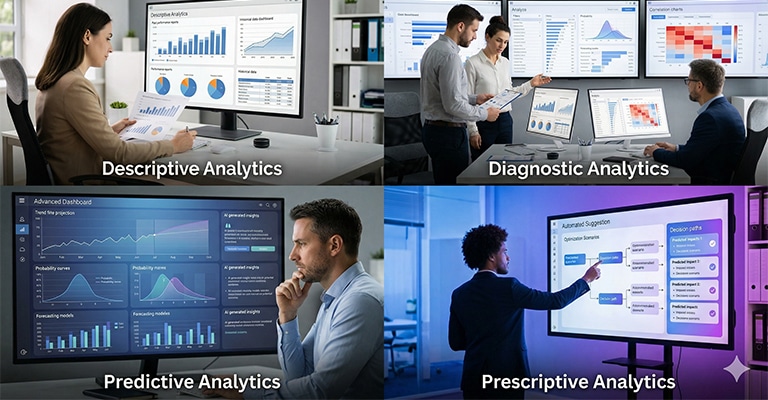
It helps to see how predictive analytics fits alongside other analytical approaches.
| Analytics Type | Core Question | Example |
| Descriptive | What happened? | Monthly sales report |
| Diagnostic | Why did it happen? | Root cause of a sales drop |
| Predictive | What will happen? | Next quarter’s revenue forecast |
| Prescriptive | What should we do? | AI-recommended pricing strategy |
Predictive analytics sits in the third tier. It is more advanced than descriptive and diagnostic analytics. It does not recommend actions on its own. Prescriptive analytics takes things a step further by suggesting what you should do based on the prediction.
Most organizations use all four types together. Predictive analytics is the bridge between understanding the past and optimizing the future.
How Does Predictive Analytics Work?
Predictive analytics follows a clear, repeatable process. You do not need to be a data scientist to understand it. At the heart of the process is a model, a mathematical tool trained on your data to generate predictions. Think of it like a recipe: data goes in, forecasts come out. Here are the four steps.
Step 1: Collect and Prepare Your Data
Every prediction starts with data. You need historical records such as sales figures, patient health data, website behavior data, or financial transaction data.
Raw data is rarely clean. You must handle missing values, remove duplicates, and standardize formats. This step is called data preprocessing. It is the most time-consuming part of the process.
Poor data quality leads to poor predictions. Garbage in, garbage out.
Step 2: Choose a Predictive Model
Once your data is ready, you select a model. Your choice depends on what you want to predict. Are you forecasting a number like revenue? Use a regression model. Sorting records into categories like “fraud” or “not fraud”? Use a classification model.
Understanding machine learning algorithms helps you make smarter model choices.
Step 3: Train and Test the Model
Next, you feed the model your historical data. The model learns patterns from that data. Then you test it on data it has never seen before. This step measures its accuracy.
This process is called training and validation. It tells you whether your model performs well on new, unfamiliar data or merely memorizes what it has already seen.
Good AI model training separates a useful model from a misleading one.
Step 4: Deploy and Monitor Results
Finally, you deploy the model to make real-world predictions. But your job is not done. Models degrade over time as data patterns shift. You must monitor performance and retrain periodically.
Deployment without monitoring is one of the most common mistakes in predictive analytics.
What Are the Main Types of Predictive Analytics Models?
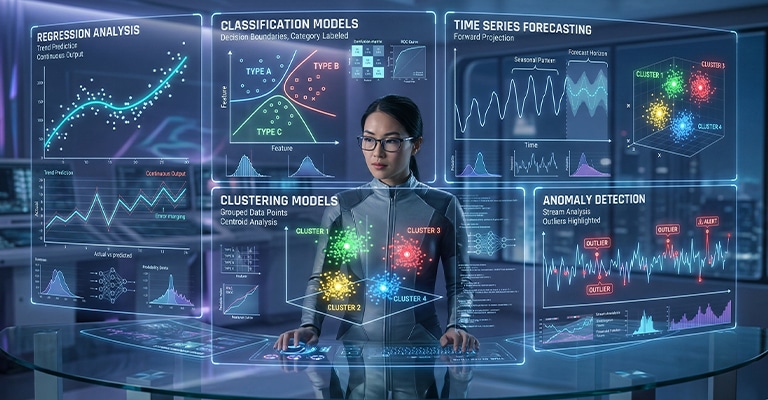
Not all predictive analytics models work the same way. Here are the four you will encounter most often.
- Regression Models predict a specific number. For example, they forecast next month’s sales revenue or a patient’s blood pressure reading. Linear regression is the simplest form.
- Classification Models sort data entries into distinct groups. A spam filter classifies emails as “spam” or “not spam.” Credit scoring (a system that rates how likely someone is to repay a debt) classifies applicants as “approve” or “decline.”
- Time Series Models analyze data points collected over time to spot trends and seasonality (predictable patterns that repeat at regular intervals, like higher retail sales every December). Retailers use them for demand forecasting. Investors use them to model stock movements.
- Neural Network Models are more complex and capable. They identify subtle patterns, including nonlinear ones (complex relationships that do not follow a simple straight line), in large datasets. Deep learning, a method that stacks many layers of AI processing to recognize complex patterns, has made neural network-based prediction far more powerful and accessible.
Each model type has strengths and limitations. The right choice always depends on your specific data and goal.
Where Is Predictive Analytics Used in the Real World?
Predictive analytics is not an abstract concept. It is already at work behind the scenes in the industries you interact with every day.
Healthcare and Disease Risk
Hospitals use predictive analytics to identify patients at risk of readmission, sepsis (a dangerous, whole-body response to infection), or chronic disease. Models analyze lab results, vital signs, and medical history to flag high-risk individuals early.
This enables earlier intervention and better patient outcomes. Predictive models have been shown to significantly reduce hospital readmission rates when applied consistently (National Institutes of Health, PubMed Central).
Finance and Fraud Detection
Banks use predictive models to spot unusual transaction patterns in real time. When your card gets flagged for an unexpected purchase, that is a classification model at work.
Credit scoring is another major use case. Lenders assess default risk (the chance a borrower will not repay their loan) by analyzing the borrower’s financial history and behavior. You can explore this further in our guide to AI fraud detection.
Marketing and Customer Behavior
Marketers use predictive analytics to identify which customers are likely to churn, respond to an offer, or make a purchase. This enables highly targeted campaigns that waste less budget.
Companies that use data-driven targeting see significantly higher conversion rates (the percentage of people who take a desired action, such as making a purchase) than those relying on intuition alone (Harvard Business Review). Sentiment analysis also pairs naturally with predictive models to track shifting customer attitudes. This directly supports smarter AI marketing strategies.
Supply Chain and Demand Forecasting
Retailers and manufacturers use time series models to forecast demand. This prevents costly overstock and stockouts. Large-scale logistics companies rely heavily on predictive analytics for inventory planning and delivery optimization.
How AI Makes Predictive Analytics More Powerful

Traditional predictive analytics relied on structured data (information organized neatly into rows and columns, like a spreadsheet) and rule-based models (systems that follow explicit IF-THEN instructions written by humans). AI has changed everything.
Machine learning allows models to learn from far more complex datasets. Models are not manually programmed with rules. They detect subtle patterns that no human analyst would spot. 88% of companies globally now use AI in at least one business function (McKinsey). That figure, up from 78% just one year earlier, shows how quickly AI-powered forecasting has become standard practice.
Deep learning and neural networks in AI extend this further. They process unstructured data like text, images, and audio. This opens up entirely new possibilities for prediction.
Real-time processing is another major leap. Older systems produced batch predictions, where results were processed in large groups on a set schedule. Results took hours or even days. AI systems now generate predictions in milliseconds. This enables instant fraud alerts, real-time recommendations, and live risk scoring.
Supervised learning (where models train on labeled examples with known correct answers) and unsupervised learning (where models find patterns in data without any pre-labeled guidance) power most modern predictive models. Understanding both gives you a strong foundation in AI forecasting.
Finally, automated machine learning (AutoML) platforms handle model selection and tuning (adjusting settings to improve accuracy) automatically. This makes predictive analytics accessible to teams without deep data science expertise.
Common Predictive Analytics Tools and Platforms
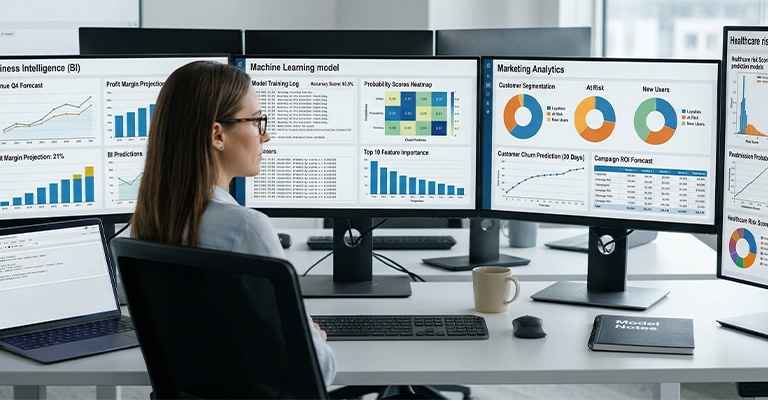
Here is a snapshot of the tools most commonly used for building and deploying predictive models. Each tool has different strengths depending on your team’s needs and technical skill level (SAS).
- Python (scikit-learn, pandas): The most popular open-source (free and publicly available) stack for data scientists and ML engineers. Highly flexible.
- R: Strong statistical computing environment favored in academic and research settings.
- IBM SPSS: Analytics software built for large organizations, with a visual interface. Common in healthcare and social sciences.
- SAS Analytics: A robust platform for regulated industries like finance and pharma.
- Google Cloud AutoML: Enables teams to train high-quality models without writing custom code.
- DataRobot: Automated machine learning platform built for business teams. Manages everything from building a model to deploying and monitoring it.
- Microsoft Azure Machine Learning: Cloud-based environment for building, training, and deploying predictive models across large datasets and organizations.
Your best tool depends on your team’s technical skill level, your budget, and where you plan to run the model.
Pros and Cons of Predictive Analytics
Advantages
- Reduces uncertainty: Replaces guesswork with evidence-based forecasts.
- Enables proactive decisions: Spot risks and opportunities before they fully emerge.
- Scales efficiently: AI models can process millions of records faster than any human team.
- Improves ROI (return on investment): Targeted predictions reduce wasted spend in marketing, operations, and risk management.
- Applicable across industries: Finance, healthcare, retail, logistics, and more all benefit.
Limitations
- Requires quality data: Biased or incomplete data produces unreliable predictions.
- Models can go stale: Patterns shift over time, requiring regular retraining.
- Black-box problem: Some complex models work like a sealed box. Their internal logic is hidden, making them hard to interpret or explain.
- Ethical risks: Biased training data can lead to discriminatory outcomes.
- Implementation cost: Building and maintaining models requires real investment.
For a deeper look at fairness issues in AI systems, see our coverage of AI business analytics.
Common Mistakes to Avoid
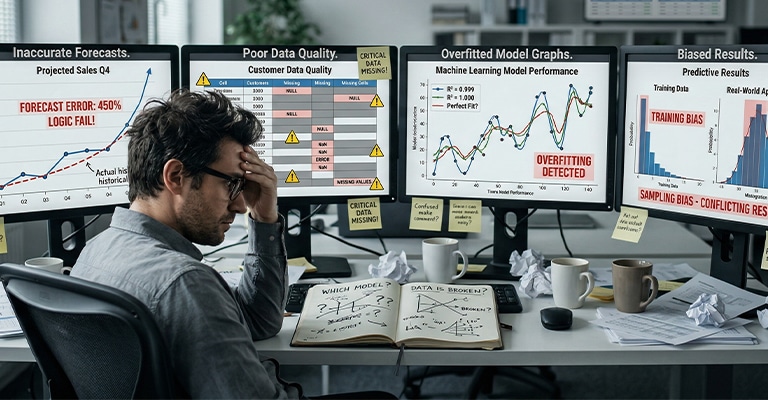
Using Dirty or Incomplete Data
Poor data quality is the leading cause of failed predictive models. If your data has missing values, duplicates, or inconsistent formats, your model will learn the wrong patterns. Before building anything, invest time in thorough data cleaning and preprocessing. The output of your model is only as good as the data you feed it.
Skipping Model Validation
Many beginners train a model on all their available data and skip proper testing. Without a holdout test set (a separate batch of data set aside solely for testing), you have no way to know whether your model generalizes to new data. This leads to overfitting, where the model memorizes past examples but fails when it encounters anything unfamiliar. Always split your data into training, validation, and test sets before you start.
Choosing the Wrong Model Type
Not every model works for every problem. Applying a regression model to a classification problem, or vice versa, yields statistically meaningless results. Before selecting a model, clearly define what you are trying to predict. If you want a specific number, use regression. If you want to sort data into categories, use classification. Matching your model type to your goal is one of the most important decisions you will make.
Deploying and Forgetting
Launching a model is not the finish line. Real-world data changes over time, and a model trained on last year’s patterns can quietly become inaccurate without any obvious warning signs. Set up monitoring dashboards (screens that track how well your model is performing over time) and schedule regular retraining cycles (feeding the model fresh data to keep its predictions accurate). Treat your model like a living tool that needs ongoing care.
Ignoring Ethical Implications
If your training data reflects historical biases, your model will too. Biased predictions can affect hiring decisions, loan approvals, and healthcare outcomes across thousands or millions of real people. Regularly audit your training data for gaps or underrepresentation, and review your model’s outputs for patterns that could lead to unfair treatment. Building accurate models and building fair ones are not the same challenge, and both deserve attention.
Over-Relying on Automation
AutoML tools can automatically build and tune models, making the process faster and more accessible. However, automation can also mask serious problems in your data. If your input data is flawed, an automated tool will confidently build a model based on that flaw without flagging it. Always take time to understand your data before handing it to an automated process. Tools are only as reliable as the judgment behind them.
Final Thoughts
Predictive analytics is one of the most useful tools in the modern AI toolkit. It turns raw historical data into forward-looking intelligence. Organizations can act before problems arise, not after.
You now understand what predictive analytics is and how it works. You know where it is used and how AI has made it faster and more powerful. That knowledge matters. Most people interact with predictive systems every day without realizing it. Now you know what is actually happening under the hood.
But knowledge is only useful when you apply it.
Here is your next step: Pick one area from this guide that interests you. Consider healthcare, marketing, finance, or supply chain. Then explore how predictive models are already shaping outcomes in that field. Start small, stay curious, and build from there.
AI is not something that just happens to you. With the right foundation, you can understand, use, and shape it. You have just taken a meaningful step in that direction.
Frequently Asked Questions
What Is the Difference Between Predictive Analytics and Machine Learning?
Machine learning is a broader technology. Predictive analytics is one of its most common applications. Machine learning algorithms learn patterns from data without being explicitly programmed. Predictive analytics uses those patterns specifically to forecast future outcomes. You can think of machine learning as the engine and predictive analytics as one of the vehicles it powers. Not all machine learning is used for prediction.
Do I Need to Know How to Code to Use Predictive Analytics?
Not necessarily. Platforms like DataRobot, Google Cloud AutoML, and Microsoft Azure ML offer visual, point-and-click environments where you build models without writing much code. However, learning the basics of Python or R gives you greater flexibility. You gain more control over data preparation, model selection, and result interpretation. Coding skills are helpful but not required to get started with predictive analytics.
How Accurate Is Predictive Analytics?
Accuracy varies widely depending on data quality, model complexity, and the nature of the problem. A well-built fraud detection model might achieve over 95% accuracy. A customer churn model in a volatile market might only reach 70-80%. Accuracy is always a range, not a guarantee. The best models combine strong algorithms with clean, balanced data that reflects real-world conditions, along with regular performance monitoring.
Is Predictive Analytics the Same as Artificial Intelligence?
No, but the two are closely connected. AI is the broader field. Predictive analytics is one specific application of AI and machine learning. Think of AI as the umbrella and predictive analytics as one tool underneath it. Predictive analytics is among the most practical and widely deployed ways that AI delivers real business value across industries today.
How Much Data Do You Need to Build a Predictive Model?
There is no fixed number, but more is better. A simple linear regression can work with a few hundred records. A deep learning model for complex pattern recognition may require hundreds of thousands of rows of data. The complexity of your problem determines how much data you need. Data quality matters just as much as volume. Clean, relevant data outperforms large amounts of messy data.
Can Small Businesses Use Predictive Analytics?
Yes. Cloud-based platforms have dramatically lowered the barrier to entry. A small e-commerce business can use off-the-shelf tools to forecast demand, personalize product recommendations, or identify at-risk customers. You do not need a dedicated data science team to get started. Tools like DataRobot and Google AutoML are built for business users who want results without deep technical knowledge.
What Is the Role of Data Privacy in Predictive Analytics?
Predictive analytics often relies on personal data. Organizations must comply with regulations like GDPR and CCPA (data privacy laws in Europe and California, respectively) when collecting, storing, and using that data. The National Institute of Standards and Technology (NIST) AI Risk Management Framework provides guidance on responsible AI deployment, including privacy protections (NIST). Privacy-preserving techniques such as data anonymization (stripping out identifying details so individuals cannot be traced) and federated learning (training AI models across devices without centralizing raw personal data) are increasingly important as predictive systems grow more widespread.
How Does Predictive Analytics Connect to Prescriptive Analytics?
Predictive analytics tells you what is likely to happen. Prescriptive analytics takes that forecast and recommends the best action. The two work in sequence: prediction first, then prescription. Many advanced AI systems now combine both in a single automated process. Understanding predictive analytics is the essential first step before moving on to prescriptive or fully automated systems in which AI operates without waiting for human input.
Key Terms Glossary
Use this table as a quick reference for the key terms covered throughout this guide.
| Term | Definition |
| Predictive Analytics | The use of historical data, statistics, and machine learning to forecast future outcomes. |
| Machine Learning | A branch of AI where models learn patterns from data rather than following pre-written rules. |
| Supervised Learning | A training method where models learn from labeled examples that already have known correct answers. |
| Unsupervised Learning | A training method where models find patterns in data without predefined labels. |
| Regression | A model type that predicts a specific number, such as revenue or temperature. |
| Classification | A model type that sorts records into categories, such as “fraud” or “not fraud.” |
| Time Series | A sequence of data points collected over time, used to identify trends and seasonal patterns. |
| Neural Network | A layered AI model loosely inspired by the human brain, capable of detecting complex patterns. |
| AutoML | Automated machine learning tools that handle model selection and tuning without manual coding. |
| Data Preprocessing | The process of cleaning and organizing raw data before feeding it into a model. |
| Overfitting | When a model memorizes training data so well that it performs poorly on new, unfamiliar data. |
| Training Data | The historical dataset used to teach a machine learning model how to make predictions. |